
If you believe your land’s value is dictated solely by its current zoning, you’re likely leaving significant capital on the table. Most landowners across British Columbia feel a justified sense of caution as they face the 2026 regulatory landscape, where even a minor CD-1 bylaw amendment in major urban centres across the province can carry a $50,000 price tag. Professional development management for landowners acts as a steady hand through this complexity; it ensures your property reaches its highest and best use while protecting your bottom line.
At Team db / Team Construction Management Ltd., we understand that navigating BC municipal bylaws and the risk of pre-construction cost overruns can feel like a daunting barrier to progress. This article provides a clear roadmap to help you realize the full potential of your property through a structured, risk-mitigated process. We’ll explore a comprehensive checklist that covers everything from leveraging new 2026 DCC deferral structures to securing the entitlements that transform raw land into a high-value, bankable asset.
Key Takeaways
- Distinguish the strategic oversight of development management for landowners from standard contracting to secure a high-level vision for your asset.
- Implement a two-phase pre-development checklist to verify legal feasibility and current market demand within the Okanagan and Vancouver Island regions.
- Manage the complexities of the Local Government Act and municipal stakeholder relations to streamline the rezoning and entitlement process.
- Assemble a specialized project team and apply disciplined cost controls to protect your budget during the critical design and planning stages.
- Leverage an integrated approach to development and construction to ensure a steady, reliable transition from your initial vision to physical reality.
What is Development Management for Landowners?
Development management for landowners is the comprehensive, strategic oversight of a real estate project from its initial concept to its final realization. It isn’t merely a set of administrative tasks; it’s a discipline rooted in foresight and meticulous planning. While some might view it as simple project coordination, it’s actually the specialized engine that drives the entire Real estate development process toward a successful conclusion. By integrating technical expertise with financial strategy, this service transforms a physical piece of land into a high-performing asset.
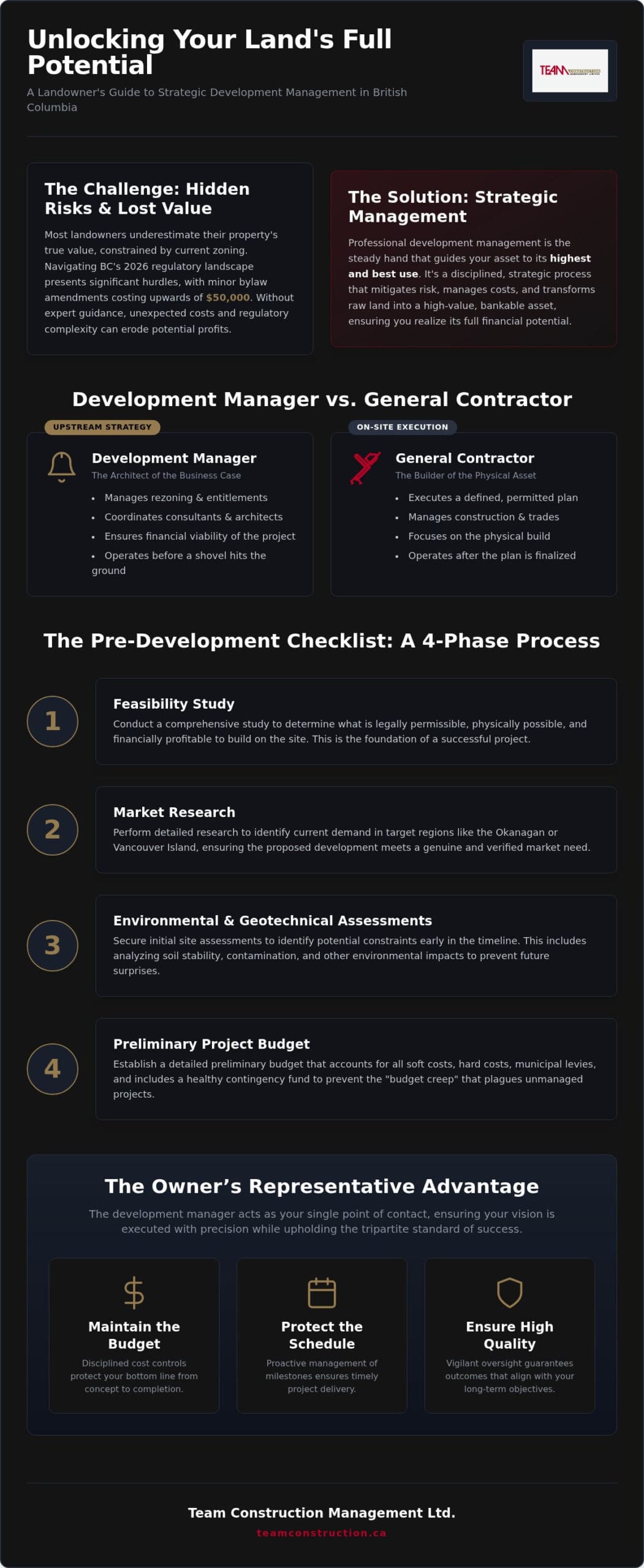
It’s vital to distinguish between a general contractor and a development manager. A contractor focuses on the physical execution of a defined plan; they build what’s already been designed and permitted. Conversely, a development manager operates much earlier in the timeline. They manage the rezoning, coordinate the consultants, and ensure the project remains financially viable before a single shovel hits the ground. This “upstream” involvement is where the most significant value is created and where the greatest risks are mitigated. Development management for landowners provides the bridge between owning a property and owning a profitable business case.
The primary objective is to identify and achieve the “highest and best use” of the land. This involves a rigorous analysis of what is physically possible, legally permissible, and financially feasible. By applying a steady, professional approach, development management ensures that every decision, from the initial site plan to the final finishing details, is aligned with maximizing the property’s ultimate worth. It’s about precision, order, and the satisfaction of a well-executed plan.
The Role of the Owner’s Representative
As an owner’s representative, the development manager acts as the single point of contact between you and a complex web of architects, engineers, and municipal officials. This role is built on transparency and communication. It’s about ensuring the project remains aligned with your long-term financial objectives while managing the delicate balance between design vision and construction reality. We focus on a tripartite standard: maintaining the budget, protecting the schedule, and ensuring high-quality outcomes at every stage.
Why Landowners Need Professional Management
Navigating the complexities of BC real estate requires more than just a vision; it requires a proven process. Without professional oversight, landowners often face the common pitfalls of unentitled property development, such as unexpected municipal fees or design flaws that hinder profitability. We leverage over 45 years of regional experience to help you navigate local market shifts and regulatory hurdles. This expertise creates a seamless bridge from initial feasibility to final occupancy, providing the peace of mind that comes from having a seasoned expert at the helm.
The Pre-Development Checklist: Assessing Your Property’s Potential
Before committing significant capital to a project, a structured order of operations is essential. Success in BC real estate isn’t found in guesswork; it’s the result of a proven process that evaluates a site’s potential through a lens of financial and regulatory reality. Effective development management for landowners begins with a four-phase assessment designed to eliminate ambiguity and establish a clear path forward.
- Phase 1: Conduct a comprehensive feasibility study to determine what can legally and profitably be built on the site.
- Phase 2: Perform detailed market research to identify current demand in the Okanagan or Vancouver Island regions, ensuring the project meets a genuine market need.
- Phase 3: Secure initial environmental and geotechnical assessments to identify site constraints, such as soil stability or the environmental impacts of land use, early in the timeline.
- Phase 4: Establish a preliminary project budget that accounts for soft costs, municipal levies, and a healthy contingency fund.
A meticulous approach at this stage prevents the “budget creep” that often plagues unmanaged projects. By identifying site constraints before the design phase matures, landowners can make informed decisions about whether to proceed, pivot, or hold. If you’re unsure where your property fits within the current market, our team provides the seasoned expert guidance needed to clarify your next steps.
Feasibility Studies: The Foundation of Success
Analyzing zoning bylaws and Official Community Plan (OCP) designations in cities like Kelowna or Victoria is the first step in any serious project. We calculate the Potential Gross Income (PGI) against projected development costs, including the new 2026 Development Cost Charge (DCC) structures where 75 percent of charges can now be deferred to occupancy. A feasibility study is the tool that prevents unviable projects from wasting capital. It provides the data required to secure financing and command respect from institutional stakeholders.
Market Research and Highest and Best Use
Identifying the “highest and best use” requires a deep understanding of regional trends. In 2026, we’re seeing a distinct shift toward “missing middle” housing and smaller, bite-sized multi-family projects in the BC interior. We evaluate whether multi-family, commercial, or industrial use provides the best return on investment for your specific location. Determining the optimal project scale at this stage ensures long-term asset stability and maximizes the eventual value of the entitlements. This foresight is what separates a standard build from a high-performing real estate asset.
Navigating British Columbia’s Regulatory Landscape
The Local Government Act serves as the primary legislative framework for land use in British Columbia. It dictates how municipalities manage growth, protect the environment, and authorize development through specific bylaws. For property owners, this legislation represents a complex set of rules that can either facilitate or frustrate a project’s momentum. Professional development management for landowners provides the necessary expertise to interpret these regulations, ensuring that every application is technically sound and strategically positioned for approval.
Early engagement with municipal stakeholders is a cornerstone of our proven process. Establishing a collaborative relationship with planning departments in regions like the Okanagan or the Fraser Valley helps identify potential roadblocks before they become costly delays. This proactive dialogue is essential when managing the transition from a Development Permit (DP) to a Building Permit (BP). We ensure that all municipal conditions, from frontage improvements to environmental setbacks, are addressed with precision and foresight.
Recent shifts in provincial policy have introduced new financial tools that landowners must understand to protect their capital. As of January 1, 2026, the structure for Development Cost Charges (DCCs) has become more flexible. Developers can now defer a significant portion of these costs, paying 25 percent at the permit stage and the remaining 75 percent at occupancy or within four years. Additionally, the expanded use of on-demand surety bonds province-wide provides a modern alternative to traditional bank letters of credit. These changes require a seasoned hand to manage, as the complexity of due diligence has increased following the 2025 Cowichan Ruling, which necessitates looking far beyond the standard land title registry.
Phased Development Agreements (PDAs)
For large-scale or multi-phase projects intended to span 10 to 20 years, Phased Development Agreements offer a vital layer of regulatory certainty. These agreements allow a landowner to lock in specific zoning and subdivision servicing provisions, protecting the project from future bylaw changes that could undermine its viability. By collaborating with local governments to create a PDA, we ensure mutual benefit and long-term project stability. This methodical approach provides the peace of mind that comes from knowing your investment is anchored by a formal, legally binding roadmap.
The Rezoning and Entitlement Process
The rezoning process requires more than just technical drawings; it requires a professional voice that can navigate public hearings and community engagement. We coordinate with a specialized consulting team to address municipal concerns while maintaining the project’s core financial objectives. In 2026, fee structures are rising, with the District of Lake Country implementing annual 2 percent increases and Vancouver charging C$50,000 for even minor CD-1 bylaw amendments. We ensure every submission is meticulous, transparent, and designed to meet the high standards of BC’s evolving regulatory environment. For Okanagan property owners seeking to understand how to align approvals with construction feasibility, our detailed guide to land development management in Kelowna outlines a construction-first framework for navigating these complexities profitably.
The Management Checklist: Coordinating the Project Team
The transition from securing entitlements to managing a full project team is the stage where a landowner’s vision is either reinforced or compromised. Professional development management for landowners ensures that this transition remains seamless, disciplined, and focused on the tripartite goals of budget, schedule, and quality. Coordinating a diverse group of specialists requires a steady hand and a proven process to maintain momentum and ensure that every consultant remains aligned with the owner’s financial objectives.
- Step 1: Assemble a world-class consulting team. We curate a group of architects, structural engineers, and landscape designers—supported by the high-accuracy survey data provided by Site Wiz Surveys—who possess specific experience in BC’s multi-family and commercial sectors. This selection process is based on a history of reliability and a shared commitment to precision.
- Step 2: Implement rigorous cost control strategies. This prevents budget creep during the detailed design phase, ensuring the project remains financially viable as it moves toward construction.
- Step 3: Establish a realistic project schedule. Clear milestones and accountability are essential for tracking progress, managing lender expectations, and maintaining team focus.
- Step 4: Manage the procurement process. We ensure high-quality materials and skilled trades are secured at competitive rates through a transparent, competitive bidding process.
By centralizing communication through a single point of contact, we eliminate the fragmentation that often leads to errors. Our team acts as the bridge between your high-level vision and the physical reality of the site. If you’re ready to move from the planning phase to active execution, our development management services provide the stable leadership and expert oversight your project requires to succeed.
Cost Control and Budgeting Services
Value engineering is a core component of our methodology. It allows us to maintain design integrity while identifying opportunities to reduce unnecessary expenses without sacrificing the final quality of the asset. We regularly update the project pro forma to reflect real-time market conditions and shifting construction costs in the BC interior. Cost control is a proactive discipline, not a reactive accounting task. It requires constant foresight to identify potential financial risks before they manifest as overruns, ensuring the project’s profitability remains protected.
Logistics and Schedule Management
Effective logistics management is particularly critical in regions like the Okanagan and Vancouver Island, where supply chain disruptions can impact project timelines. We identify long-lead items early, ensuring materials are ordered well in advance of their required installation date. Our approach follows a linear progression of thoughts, moving from the broad vision of the landowner to the specific site execution required by the trades. Transparent communication between all stakeholders prevents the site delays that often result from fragmented management, keeping the project on track for a successful realization.
From Vision to Realization: The Team Construction Advantage
Team Construction Management Ltd. (Team db) offers a unique advantage rooted in over 45 years of industry experience across British Columbia. This longevity provides a level of stability and quiet confidence that is essential when navigating the high-stakes environment of property development. By integrating development management for landowners with our proven construction expertise, we eliminate the traditional friction between design and execution. This collaborative partnership model ensures that your project remains focused on the high standards of the craft while adhering to the practicalities of the budget, schedule, and quality.
Our commitment extends beyond the physical structure. We value the long-term impact of our work on the local community, striving for outcomes that reflect both innovation and traditional values of accountability. This perspective allows us to act as a seasoned expert and a dedicated guide, transforming your vision into a high-value asset through a process that is transparent, methodical, and reassuringly predictable. We don’t just build structures; we build the foundations for long-term economic stability and community growth.
Why Experience Matters in the Okanagan
Deep-rooted relationships are the currency of successful development in regions like Kelowna and the wider Okanagan. We leverage decades of cooperation with local sub-trades, municipal offices, and institutional stakeholders to ensure project momentum. Our team applies lessons learned from 45 years of multi-family, commercial, and industrial project delivery to foresee challenges before they arise. This foresight provides the peace of mind that comes from a steady, professional hand at the helm. It allows you to focus on your long-term financial objectives while we manage the complexities of the site with meticulousness and care. Experience in the BC interior means understanding the nuances of local soil conditions, seasonal weather windows, and regional market demands. Landowners evaluating partners in the region can also consult our comprehensive 2026 selection guide for land development management in Kelowna to understand the criteria that distinguish a construction-ready management team from a purely administrative one.
Your Next Steps as a Landowner
Realizing the highest and best use of your property begins with a clear roadmap and a reliable partner. Our process starts with an initial consultation to assess your specific goals and the unique potential of your land asset. From there, we establish a comprehensive roadmap for feasibility, entitlement, and eventual construction. This structured approach ensures that every step is taken with precision and purpose, moving you from a broad vision to a successful realization. We invite you to Contact Team Construction to discuss your development project today and discover how a collaborative partnership can maximize your property’s value.
Securing the Future of Your Development Project
Transforming raw land into a high-value asset requires more than just a vision; it demands a disciplined approach to risk and regulation. We’ve explored how a structured pre-development checklist and a deep understanding of BC’s evolving municipal bylaws create a foundation for long-term success. By prioritizing a tripartite focus on budget, schedule, and quality, you ensure your project remains financially viable from the first feasibility study to final occupancy.
Professional development management for landowners provides the steady hand needed to navigate these complexities with confidence. With over 45 years of professional project delivery, our team specializes in the multi-family, commercial, and industrial developments that shape our local communities. We provide comprehensive oversight from initial feasibility to final completion, acting as your dedicated representative at every stage. It’s time to move beyond uncertainty and toward a bankable reality. Partner with Kelowna’s seasoned experts to maximize your land’s value and take the first step toward a successful realization of your property’s potential.
Frequently Asked Questions
What is the primary difference between a development manager and a general contractor?
A development manager provides strategic oversight from a project’s inception, while a general contractor focuses on the physical construction of a defined plan. The manager handles rezoning, feasibility studies, and consultant coordination before a shovel hits the ground. The contractor manages trades and site safety once the design and permits are finalized.
How much does development management cost for a landowner in BC?
Fee structures for development management in British Columbia are typically based on the specific scale and complexity of the project. Landowners should seek a tailored proposal to understand the professional requirements for their unique site. This ensures the management services are aligned with the project’s long-term financial objectives and value creation.
Do I need a development manager if I already have an architect?
Yes, because an architect focuses on design and building code compliance rather than the overall business case or municipal negotiations. A development manager provides the broader oversight needed to keep the budget on track and the project aligned with your commercial goals. They bridge the gap between creative design and construction reality.
How long does the land entitlement process typically take in the Okanagan?
The entitlement process in the Okanagan varies significantly depending on the municipality and the complexity of the land use change. While a standard Development Permit might take several months, a complex rezoning application often requires a year or more for full approval. Professional management helps streamline these timelines through early stakeholder engagement and meticulous submissions.
Can development management help with multi-family zoning changes?
Yes, development management for landowners is highly effective for navigating complex multi-family zoning changes. We coordinate the technical submissions and community engagement required to meet municipal standards in BC. This process ensures your property is positioned for its highest and best use while mitigating the risks of public hearing delays.
What is a feasibility study and why is it the first step for landowners?
A feasibility study is a rigorous analysis that determines if a project is physically possible, legally permissible, and financially viable. It’s the essential first step because it identifies the property’s highest and best use before you commit significant capital. This study prevents landowners from wasting resources on projects that don’t meet market demand or regulatory requirements.
How does an owner’s representative mitigate project risks?
An owner’s representative acts as a single point of contact to ensure every decision remains aligned with your project’s long-term financial objectives. They use foresight and meticulous planning to identify potential budget overruns or schedule delays before they manifest. This steady leadership provides the peace of mind that comes from having a seasoned expert protecting your interests.
Does Team Construction work on small-scale residential renovations?
Team Construction does not offer services for small-scale residential renovations or individual homes. Our expertise is focused on large-scale multi-family, commercial, industrial, and institutional construction projects. We provide the specialized oversight and proven process required for complex, high-value assets across British Columbia. For homeowners in the Victoria area looking for residential support, you can learn more about NEXERA Home Renovations to find a specialist for your home project.