
In British Columbia’s current regulatory climate, a project’s success is no longer determined by the quality of the design alone, but by the precision of its technical navigation. You likely recognize that the era of straightforward approvals has passed, replaced by a complex network of Step Code requirements, shifting municipal bylaws, and the new 7% PST on professional services. Implementing professional development management British Columbia has evolved from a luxury oversight role into an essential risk-mitigation strategy. It provides the stability, foresight, and meticulous planning required to protect your capital in a volatile labour market.
We understand the pressure of managing cost overruns while coordinating complex rezoning under the provincial deadlines of 2026. This guide will help you master these complexities, offering expert insights into feasibility, rezoning, and professional project delivery. We’ll provide a clear roadmap from land acquisition to final occupancy, ensuring you maintain confidence in your project’s ROI. By understanding the regional nuances of the Okanagan and Vancouver Island, you can transform legislative hurdles into tangible opportunities for growth and community impact.
Key Takeaways
- Understand the three pillars of strategic oversight—financial viability, regulatory navigation, and physical execution—to ensure your project remains anchored by a proven process.
- Master the full lifecycle of development management British Columbia, moving methodically from the initial feasibility study through to final occupancy.
- Distinguish between the high-level strategic goals of development management and the tactical execution of project management to maintain alignment with your long-term vision.
- Learn to mitigate modern risks, including the evolving BC Energy Step Code requirements and labour volatility in the Okanagan and Vancouver Island markets.
- Discover how to select a development partner who combines a history of success in multi-family and commercial sectors with deep regional expertise.
What is Development Management in British Columbia?
Development management in British Columbia represents the high-level, strategic oversight of a real estate asset’s entire lifecycle. It begins at the earliest stages of inception and continues through to the final stabilization of the property. While many confuse this role with site-level supervision, it’s actually a comprehensive leadership position that safeguards the owner’s capital and vision. It is the steady hand that guides a project through the inevitable fluctuations of the market.
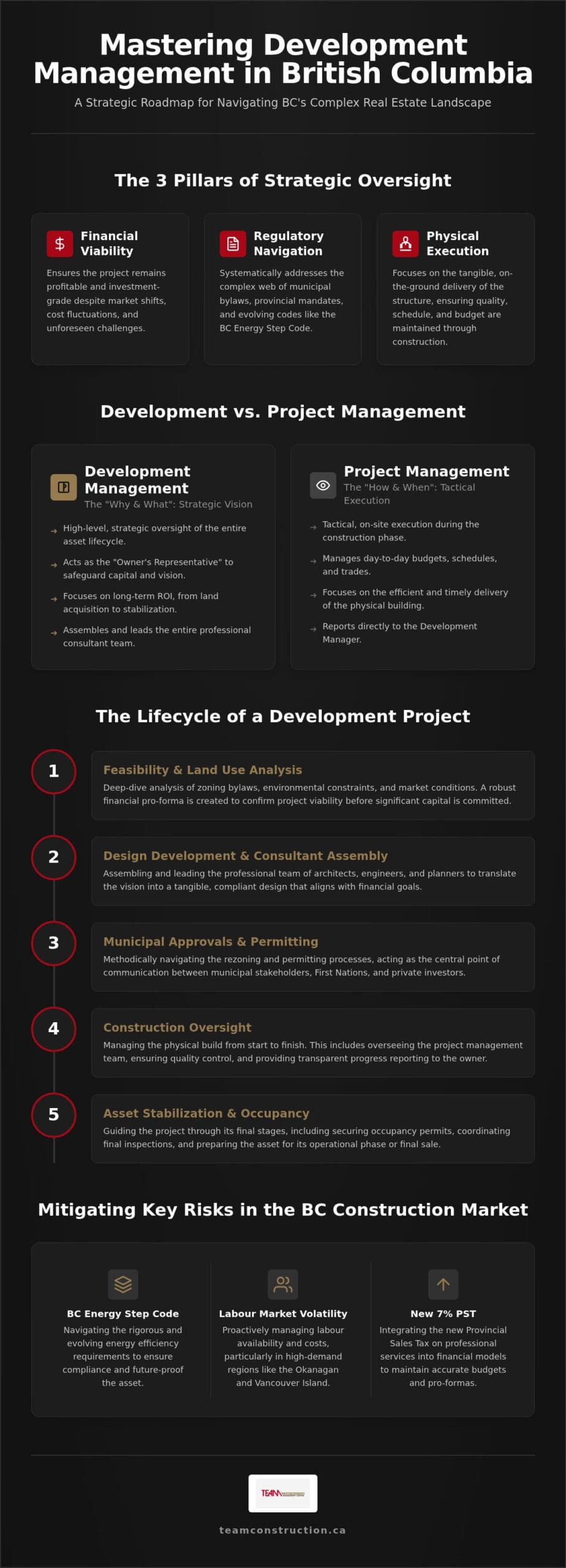
The process is anchored by three fundamental pillars: financial viability, regulatory navigation, and physical execution. Every decision made during the real estate development process must balance these three elements. Financial viability ensures the project remains profitable despite market shifts. Regulatory navigation addresses the complex municipal and provincial mandates. Physical execution focuses on the tangible delivery of the structure itself. When these pillars are aligned, the result is a project that meets its financial goals while contributing to the community’s fabric.
In the context of development management British Columbia, the manager acts as the “Owner’s Representative.” They serve as the primary strategic lead, bridging the gap between a conceptual idea and a physical reality. This role is vital because BC’s unique geography and evolving regulatory environment leave little room for error. With the introduction of new PST requirements on professional services and the rigorous BC Energy Step Code, having a seasoned expert to manage these details is no longer optional; it’s a requirement for success.
The Core Responsibilities of a BC Development Manager
A development manager’s responsibilities are both broad and meticulous. They begin with strategic planning to identify the highest and best use for a specific parcel of land. From there, they assemble and lead the professional consultant team, including architects, engineers, and planners. By maintaining a methodical flow between municipal stakeholders and private investors, the manager ensures the project remains on schedule. They act as the central point of communication, providing transparency and accountability at every stage of the build.
Why Regional Expertise in the Okanagan and Interior Matters
Regional knowledge is a critical asset when developing outside the Lower Mainland. Navigating the specific bylaws of municipalities like Kelowna, Vernon, and Kamloops requires deep-rooted local connections and a history of successful collaboration. Market demands in the Interior differ significantly from coastal regions, particularly regarding the balance between multi-family residential and industrial spaces. Beyond policy, the manager must also account for the logistical realities of the BC Interior, including seasonal weather patterns, transportation routes, and local labour availability. Working with established commercial construction companies in Kelowna who understand these regional dynamics is essential for maintaining project momentum and budget integrity.
The Lifecycle of a Development Project: A Methodical Approach
Success in the BC market is built on a foundation of sequence and order. A project’s lifecycle is a series of interconnected phases, where the integrity of one stage directly impacts the viability of the next. By following a linear progression, developers can avoid the common pitfalls of site delays and mid-construction redesigns that often erode profit margins. It’s about moving forward with a steady hand rather than rushing into uncertainty.
Effective development management British Columbia ensures that this progression remains predictable. It begins with pre-construction feasibility and moves through design development, municipal approvals, construction oversight, and finally, asset stabilization. This methodical approach is essential when navigating BC’s Land Use Planning Framework, which requires deep coordination between local governments, First Nations, and private stakeholders to realize a successful build.
Phase 1: Feasibility and Land Use Analysis
Before any significant capital is committed, a deep-dive analysis is required. This involves examining zoning bylaws, existing encumbrances, and potential environmental constraints that could hinder progress. A robust pro-forma must be built, specifically accounting for 2026 construction costs and current interest rates. This stage culminates in a clear ‘go/no-go’ decision, providing a moment of clarity that protects the investor’s long-term interests before the project advances. For landowners seeking to understand how this process applies specifically to their property, a structured development management for landowners checklist can help identify opportunities to maximize property value before committing capital.
Phase 2: Navigating BC Rezoning and Entitlements
Securing a Development Permit (DP) in BC municipalities is a specialized process that requires patience and professional poise. It involves managing community engagement and public hearings with transparency and quiet confidence. The goal is to obtain all necessary entitlements so the project becomes truly ‘shovel-ready’. Professional guidance at this stage, such as the development management services provided by experienced firms, ensures that municipal requirements are met without compromising the project’s original intent.
Once permits are in hand, the focus shifts to construction management and rigorous site oversight. This phase demands meticulous coordination of trades, schedules, and materials to maintain the project’s momentum. Finally, the project reaches close-out and occupancy. Here, the focus is on asset stabilization, ensuring the physical reality of the building matches the financial vision established during the feasibility stage. This orderly transition from concept to completion is what defines a high-standard development process.
Development Management vs. Project Management: Realizing the Difference
Confusion between these two roles often leads to significant gaps in project accountability. While they are closely related, they operate at different altitudes of the project lifecycle. In the context of development management British Columbia, the distinction is vital for maintaining the integrity of large-scale investments. One role focuses on the high-level vision and financial health, while the other focuses on the precision of the physical build.
Think of development management as the strategic “What” and “Why” of a project. It involves the business-level decisions that determine if a project should exist and how it will perform as a long-term asset. Project management, by contrast, is the engine of tactical execution; it is the “How” and “When.” It manages the daily realities of the construction site to ensure the project meets its specific milestones. Large-scale developments in BC require both skill sets to be successful. Without strategic oversight, a project may be well-built but financially unviable. Without tactical execution, even the most brilliant vision will never leave the page.
Strategic vs. Tactical Oversight
A development manager’s primary mandate is the protection of the developer’s equity and the realization of the projected ROI. They analyze market trends, manage the capital stack, and ensure the project remains aligned with the original feasibility study. This foresight is critical for maintaining financial stability when market conditions shift or new regulations emerge. It’s about ensuring the project’s physical reality matches its financial vision.
The project manager operates within a tighter, more immediate frame. Their priority is the daily schedule, the specific budget for materials, and the quality of the workmanship on-site. When these two roles are aligned under a single, integrated firm like Team db / Team Construction Management Ltd., the synergy is palpable. It creates a seamless loop of communication where strategic goals inform every site decision. This integration eliminates the friction that often occurs when separate entities try to coordinate complex, competing goals.
Risk Allocation and Mitigation Strategies
Identifying risks requires a methodical, dual-track approach. A development manager is responsible for spotting financial and regulatory risks before they manifest as site delays. This includes preparing for new provincial tax changes or anticipating the complexities of the BC Step Code early in the design phase. Physical risks are then mitigated during the construction phase through professional delivery and active site oversight. To maintain high standards, a firm must focus on three key areas of accountability:
- Coordinating specialized trades, including professional painting and finishing from bcinteriorpaintingpros.com, to ensure the quality of the craft remains consistent.
- Managing supply chain logistics to prevent costly material delays in the Interior.
- Ensuring all professional consultants remain accountable to the project’s timeline and budget.
This comprehensive oversight ensures that every decision made on-site is anchored by the project’s long-term financial health. It provides a sense of security to institutional stakeholders who require both precision in execution and stability in management. By bridging the gap between vision and reality, Team db / Team Construction Management Ltd. provides the steady hand necessary for complex builds.
Mitigating Risk in the British Columbia Construction Market
Risk management in the current construction landscape requires more than just foresight; it requires a proven methodology for technical navigation. In British Columbia, the mandatory adoption of higher levels of the BC Energy Step Code and the transition toward zero-carbon building requirements have fundamentally changed the approach to design and execution. We utilize 45 years of regional experience to foresee these shifts, ensuring that development management British Columbia remains a proactive rather than reactive process. By identifying these regulatory hurdles during the earliest stages of planning, we prevent the mid-build surprises that often derail project timelines and erode capital.
Managing supply chain volatility and labour shortages, particularly in high-growth areas like the Okanagan and Vancouver Island, demands a collaborative partnership model. We focus on securing long-term relationships with trusted trades and consultants to ensure stability. This is why our Pre-Construction Planning Services are so critical. They allow us to lock in essential resources and refine the project scope before the first shovel hits the ground, effectively bypassing the regional pitfalls that often trap less experienced developers. It’s about creating a steady environment where precision is the standard, not the exception.
Cost Control and Budgetary Discipline
Maintaining budgetary discipline in 2026 requires a three-tiered approach: rigorous cost-reporting, strategic value engineering, and meticulous contingency management. For institutional stakeholders, transparency is paramount. We implement detailed reporting structures that provide a clear view of the project’s financial health at any given moment. This includes accounting for the new 7% PST on professional services, which became effective October 1, 2026. Value engineering is never about compromising the craft; it’s about optimizing the methodology to ensure a high-quality outcome within the established financial framework. We manage the contingency fund with foresight, ensuring it remains a tool for stability rather than a buffer for poor planning.
Ensuring Regulatory Compliance and Safety
Staying ahead of evolving provincial safety standards and building codes is a full-time commitment. With municipalities required to comply with new housing density mandates as of mid-2026, the regulatory environment is in a state of constant motion. Our team maintains a constant, professional presence on-site to ensure high standards are met at every stage of the build. We coordinate final inspections and occupancy permits with precision, ensuring a smooth transition from the construction phase to final stabilization. The same meticulous compliance standards that govern multi-family and commercial builds are equally critical in specialized institutional environments; our approach to healthcare facility construction management BC demonstrates how rigorous regulatory oversight protects both project timelines and the communities these buildings serve. To protect your investment and ensure a seamless delivery, consider partnering with a firm that provides comprehensive commercial and multi-family construction oversight.
Selecting a Development Management Partner in BC
Choosing a partner defines the trajectory of your capital and the final quality of the physical asset. In a market as nuanced as 2026, a partner must offer more than just a list of completed projects. You should prioritize a firm with a proven track record in your specific sector, whether that involves multi-family, commercial, or industrial construction. This specialization ensures the team understands the granular requirements of your asset class. Effective development management British Columbia relies on this depth of knowledge to navigate the specific challenges of the regional market.
Regional expertise is equally vital. Firms with deep local roots in the Kelowna and Okanagan regions possess a historical understanding of municipal expectations and local labour dynamics. When evaluating commercial construction companies in Kelowna, assess their communication style; it should reflect a sense of quiet confidence and total transparency. You need a steady hand that manages the entire lifecycle of the project, from the initial vision to final asset stabilization. This holistic oversight prevents the fragmentation that occurs when shifting between different consultants for each phase of the build. It ensures that the strategic vision established during feasibility remains intact through to occupancy. For those specifically focused on site acquisition and entitlements in the region, a dedicated guide to land development management in Kelowna can provide a construction-first framework for aligning municipal approvals with project feasibility from day one.
The Team db / Team Construction Management Ltd. Advantage: 45 Years of Excellence
Our firm brings a legacy of professional project delivery that spans over 45 years across British Columbia. We’ve built our reputation on a foundation of reliability, precision, and long-term stability. The collaborative approach at Team db / Team Construction Management Ltd. ensures that every stakeholder is aligned with the project’s strategic goals. We remain deeply committed to the local community, recognizing that the buildings we manage today will have a lasting impact on the region’s landscape for years to come. This commitment to excellence allows us to command respect from institutional stakeholders and private investors alike. It is a persona that values honesty and open dialogue, portraying itself as an innovator that stays ahead of industry trends while remaining anchored by traditional values of hard work.
Next Steps for Your BC Development
Initiating your next project begins with a methodical assessment of its potential. Our seasoned experts can lead a comprehensive feasibility study to determine the highest and best use for your land while accounting for modern regulatory shifts. We value a partnership built on honesty, open dialogue, and a shared commitment to high standards. By preparing for a collaborative relationship early on, you ensure your project is anchored by a proven process and a clear roadmap to success. This steady pace ensures you feel informed and supported at every level of the narrative. Contact Team db / Team Construction Management Ltd. today to discuss your development vision.
Securing Your Project’s Future in a Shifting Market
Mastering the distinction between strategic oversight and tactical execution is the first step toward safeguarding your capital. By prioritizing a methodical lifecycle approach, you can navigate the 2026 regulatory landscape with precision and poise. This ensures that your multi-family or commercial project remains financially viable despite shifting building codes, new tax mandates, and labour volatility. Professional development management British Columbia provides the stability needed to transform a conceptual vision into a high-quality physical reality. It’s about maintaining a proven process that prioritizes transparency and long-term asset health.
With over 45 years of construction experience specialized in the multi-family and commercial sectors, our Kelowna-based team offers the province-wide reach required for large-scale success. We act as a bridge between your vision and the complex requirements of the modern BC market. Partner with BC’s seasoned experts in development management. We look forward to bringing a steady hand and meticulous planning to your next landmark project.
Frequently Asked Questions
What is the typical fee structure for development management in BC?
Development management fees are typically structured as a percentage of the total project cost or a monthly retainer based on the specific scope of work. These fees reflect the strategic oversight and risk mitigation provided throughout the asset’s entire lifecycle. While industry averages vary, the structure is designed to align the manager’s incentives with the project’s financial success and long-term stability.
How long does the rezoning process usually take in the Okanagan?
The rezoning process in the Okanagan generally takes between 12 to 18 months, depending on the complexity of the land use change and the specific municipality’s current backlog. Projects requiring significant community engagement or complex environmental assessments may extend beyond this timeframe. A methodical approach to pre-application meetings can help identify potential hurdles early, ensuring a smoother progression through the public hearing stages.
Does Team db / Team Construction Management Ltd. handle small-scale residential renovations?
Our firm focuses exclusively on large-scale development management and construction projects; we don’t handle small-scale residential renovations. Our expertise is tailored to the complexities of multi-family, commercial, institutional, and industrial sectors. For those seeking specialized residential expertise in the Lower Mainland, you can learn more about Vancouver Custom Homes for projects such as high-end custom builds and laneway housing.
What is the difference between a development manager and a general contractor?
A development manager provides strategic, business-level oversight of the entire project, while a general contractor focuses on the tactical execution of the build on-site. The development manager acts as the owner’s representative, managing the consultant team and financial viability. The general contractor is responsible for the daily coordination of trades, site safety, and physical construction according to the approved plans.
Can you provide development management for projects on Vancouver Island?
Yes, we provide comprehensive development management British Columbia services across the entire province, including Vancouver Island. Our regional reach allows us to bring the same level of precision and quiet confidence to projects in Victoria and Nanaimo as we do in the Okanagan. We leverage our 45 years of experience to navigate the unique logistical and regulatory nuances of island-based construction.
How does the BC Step Code affect my project’s construction costs in 2026?
The BC Step Code requirements in 2026 prioritize higher energy efficiency and zero-carbon building standards, which can increase initial hard costs while lowering long-term operating expenses. These standards require meticulous planning during the design phase to integrate advanced building envelopes and mechanical systems. By addressing these requirements early, we ensure your project remains compliant with provincial mandates without compromising the overall ROI.
What sectors do you specialize in for construction management?
We specialize in the development and construction management of multi-family residential, commercial, institutional, and industrial projects. Our portfolio includes diverse assets such as mixed-use buildings, professional office spaces, and large-scale industrial facilities. This breadth of experience allows us to apply a proven process across various sectors, ensuring high-quality outcomes regardless of the project’s specific use. Institutional projects demand an especially rigorous standard of delivery; our dedicated expertise in healthcare facility construction management in BC illustrates how we apply that same proven process to the most operationally sensitive environments.
How do you manage cost overruns on large-scale commercial projects?
We manage cost overruns through rigorous pre-construction planning and transparent, real-time cost reporting. By identifying potential financial risks during the feasibility stage, we establish a realistic budget that includes appropriate contingencies for labour and material volatility. Our methodical site oversight ensures that every dollar spent is tracked, allowing us to maintain budgetary discipline on even the most complex commercial projects. Landowners and investors looking to protect their bottom line from the outset can benefit from reviewing our development management for landowners guide to maximizing property value before breaking ground.